Please remember!

The information presented on this blog represents "learning in progress" on my part, a horse owner, who was not satisfied with professional farriers and took matters in my own hands. As far as I am aware at the time of the post, the information presented is correct, but may change with me understanding more about hooves, in which case I will edit or remove the post. In order to follow my learning and understand everything about Molly's hoof, you need to start reading at the bottom.

Wednesday, May 29, 2013

bar anatomy - bar pool

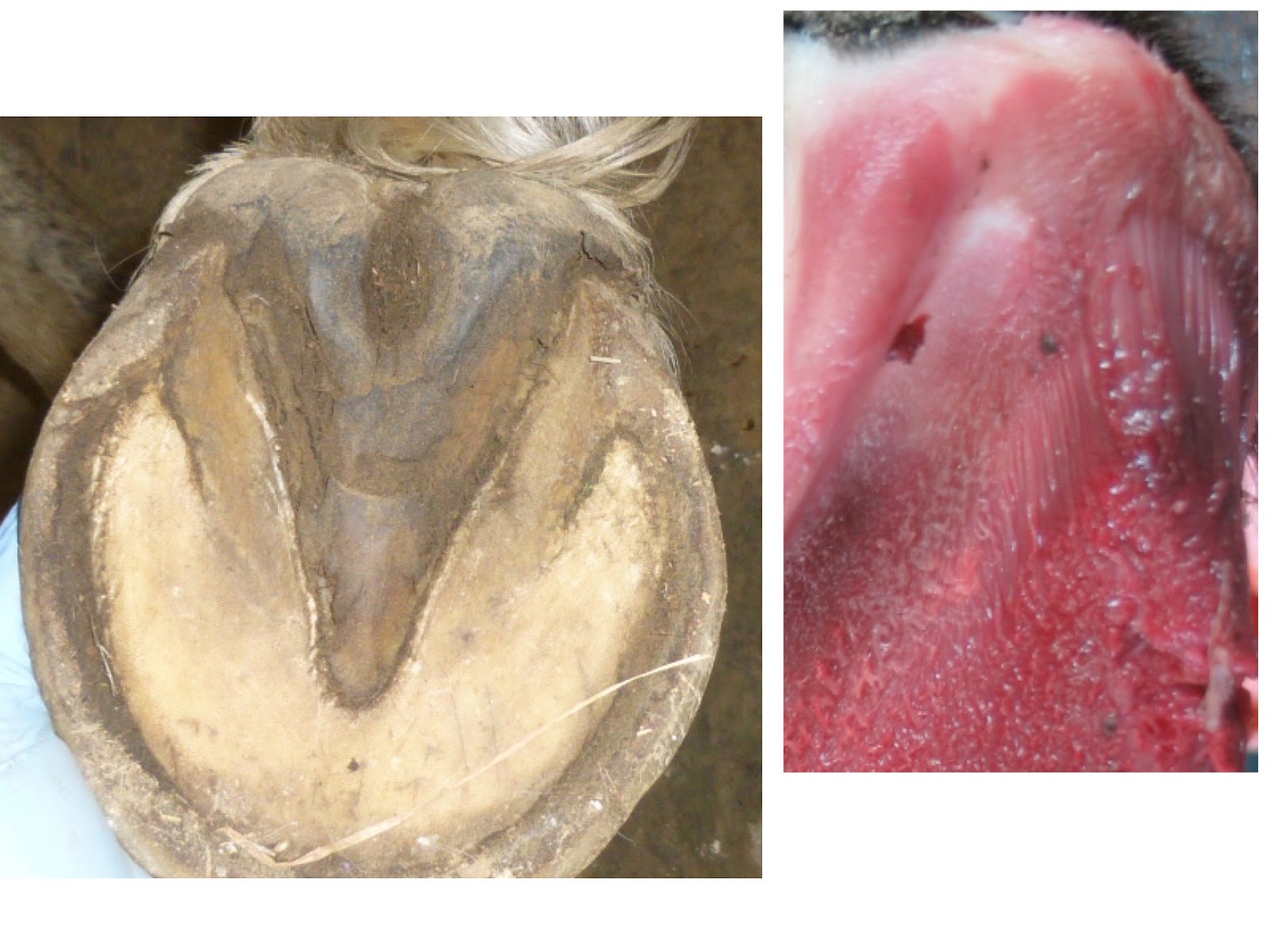
I have recently learned something new about bars. This understanding emerged from my conversation with Maureen Thierney, from Natural Barefoot Trimming and after reading her book. The picture of the healthy hoof below, which she sent to me, serves as an excellent example to explain the situation. The picture on the right is from a dissected cadaver foot, so does not represent the same foot.

This hoof (left in picture below) had just completed a 25 mile endurance race, during which the horse walked 5 miles on rock and 2 miles on pavement. The horse finished third, barefoot. I first show you the pictures without my markings.


When you look closely at the shape of the bar it does precisely match the shape of the bar corium, from which the bar grows. As an extension of the hoof wall you can easily see the wall tubules of the bar. The bar is indicated in blue below.


One can recognize the end of the bar easily by following the "dirtline", which is just an accumulation of dirt in the white line of the bar.


The material below the bar, that looks like an extension of it, is not bar, but sole build-up. You can clearly see this because there is no longer a dirtline. Whether or not this slight sole built-up has a function or not is controversial. I would think that given this horse just raced 25 miles it certainly does not look like a liability to its performance. My own experience with this material below the bar is that it does make the horse more sound. Off course, as with everything in life, the right balance is crucial.


Going back to picture 2, I have indicated how I used to trim my horse's bars, in a triangular fashion, indicated by the red triangle. I basically forced the bars to merge with the frog at the bottom of the collateral groove.


This is how many people on the internet and in barefoot trimming schools teach trimming the bars. However, if you look at the shape of the corium, and the bar on this healthy hoof, the corium has the shape of a rhomboid and not a triangle. Since the horn grows from the corium, the structures in the hoof should match their underlying corium, which it would not do when trimming the bar in a triangular fashion. Of course there will be some variation between feet, but in general, the bar corium runs in parallel to the frog, and does not merge with it. Bars trimmed in a triangular fashion remove about half of the bars supportive wall (i.e. the other part of the triangle that would fill up to the shape of the rhomboid).


Now here is an example of what you might see when you trim the bar and disrespect the shape of its corium. I cannot show the picture on my blog, due to copyright reasons, so you have to klick HERE:

http://www.thehorseshoof.com/pix/trimbefore.jpg

The right side of the picture shows the trimmed hoof, with a triangular bar trim. At the end of the bar, you can see how this trim exposes the inner hoof wall and white line (it basically exposes a white "blob" at the lower end of the bar), especially well visible on the right half of the hoof. This is an unphysiological state for the bar to be in.

Now there are some people, who then go ahead and say that this white material, that is exposed after a triangular bar trim represents "bar pool". They recommend removing it and I have seen people trying to do that literally for years. But they always hit blood very soon and then needed to stop. This is due to the fact that the triangular bar trim already removed half of the bar's wall, and so one operates already very close to the bar corium.

So maybe, next time when someone hears about the "bar pool" that requires removing, consider the alternative explanation, that the bar trim was unphysiologial and did not follow its underlying corium.

Wednesday, May 22, 2013

A powerful demonstration of Gus' role as "leading stallion" in their community of two

I just experienced the most amazing thing. Molly has the new Zebra fly blanket. She has been wearing it for a few days now, but never in the big turnout, i.e. together with Gus. Only separated in her small individual paddock. Today, I saw her rolling twice in the blanket and I thought everything is fine, the blanket stayed put, so it would be time to turn her out together with Gus wearing that blanket.

Oh my god! Gus did not recognize Molly. He thought a new stallion had appeared on the scene and his mare had disappeared, and he went straight into attacking mode. Really, just the same as one can see those mustang stallions fighting each other in the wild. Gus was crazy, gaping his mouth open, rising high in the air, chasing Molly like I had never seen before. Molly kicked and squeeked of course, but really could not believe what was going on. They had been such a perfect couple for a long time now, with defined roles as mare and stallion (though he is a gelding of course).

I managed to get Gus out of there, he had a few hoof prints on his chest but thankfully both horses are unharmed. Next, I took the blanket off of Molly and let Gus back in the big turnout area. He immediately recognized Molly, moved her a few steps around, like he always does, throwing his head until she slowly walks in front of him where he wants her to move and then he hid his head under her tail, something he does to get rid of flies. Both horses were one heart and one soul again. Within 1 second, he had his mare back and gotten rid of that rival, and was happy.

So now I am wondering, which cue did he miss on that "new" horse. I cant imagine it is the smell, Molly had been wearing this blanket for some time and at the back there was even a pee stain. He must have missed the visual cues he is used to. That was enough for him to attack.

But it also says a lot about my Gus. Because this is how he is, in the slightest doubt that something bad could have happened he chooses the attack route. I think it is because he knows he is so strong. And he is. He would have been a wonderful powerful stallion out on the ranges with his band of mares. Now he has just one, but he will never give up on that one, that's for sure!

Sunday, May 19, 2013

News on the farm

1) My ground hog has multiplied. There are now 6 of them. Living under my tack room. Not sure if I am happy about that, but the little ones are the sweetest thing ever.. I am hoping they will all disperse at the end of the summer though.


2) Molly has speciated into a Zebra


Equine dentistry - wave mouth

The horses had their teeth floated on May 9th 2013. They had not been floated in two years. Before that, they had been floated once a year, using "powerfloat".

Dentistry is another one of those subjects were I had, until now, given away full responsibility to my vets. And they always performed powerfloats. Only recently did I become aware of the fact that there are also those who criticize powerfloats and advocate manual floats (see this website of further information).

So here is another one of those topics, where the average horse owner has to make a decision, based on very limited information and knowledge.

I personally contacted one of those "Natural Balance Dentists" but never heard back. This is the problem with rural Indiana and with just two horses. One does not have very many treatment options.


So I went with my vet who did a regular power float. Good thing about that was that I learned something new, about Molly, where I had no idea about before, namely that she has a "wave mouth".

A wave mouth can be seen here:


Because Molly was sedated I could have a long and detailed look in her mouth. My vet did not mind to wait for my to try and get some pictures. I had never before personally looked in her mouth. I noticed the wave immediately and said: "Oh, there is a wave"! My vet did not seem to be concerned about that and and I had no idea what it was and that it was a regular "condition". By the evening, I had forgotten all about it, but the next morning I typed in Google: "Wave, teeth, horse" and to my surprise found a lot of information on "wave mouth". It seems to be very common. Unfortunately, opinions differ on whether this is a normal condition or should be corrected. I have not done enough research to decide on that. The only problem I could see is that the horse would restrict its range of motion with the jars at chewing, but then, given I have never seen any problems on Molly with her chewing, I am not sure if it affects her at all. I actually think most of the chewing motion is sideways. But again, I need to read up on that some more.


Below is a picture of Molly's upper left teeth, the wave is visible if one knows it is there. It is not huge, but 100% there when looking in the mouth in person.


Unfortunately, I only had a very brief look in Gus mouth. He kept moving backwards and the Vet wanted me to stand by his bud to make him realize there is no way backwards. During the brief look I had I did not see the wave. But I really should have had a more detailed look at the end. Unfortunately, I was just happy that this whole thing was over and then forgot about it.


I just found this picture. A dead mustang in Nevada, having a wave mouth:


Saturday, May 18, 2013

Vaccinations

I started this blog initially to keep track of all the things about hooves and have easy accessible links to share with others for discussion. It now also has become a tool for me to keep track of other issues with my horses. So this entry is on my recent Vet's appointment. Three things were on the agenda:

1) vaccinations
2) teeth
3) Hoof x-rays


Unfortunately 1) and 2) are controversial issues where it is difficult for the common horse owner to make the right decisions. Many people do not vaccinate their horses anymore, or much less often, citing negative side effects, short and long term. Others vaccinate against every possible disease and because some vaccines are so inefficient, often repeat those vaccinations every 6 months.

For the longest part of my horse ownership, I would simply do what the vets told me. Back in Germany, this was also much easier, because diseases such as West Nile, WEE and EEE do not exist in the old world. So all I vaccinated was Tetanus. Germany, by now, is also Rabies free.
But now, I am living in the US, and also in a very mosquito prone area. Potomac horse fever is another disease that does not occur in Europe. So when I came to the US, my horses were all of a sudden vaccinated a LOT more.

The first vacination apointment Molly received:

1) Tetanus
2) West Nile
3) EEE +WEE
4) Potomac
5) Influenza
6) Rabies

Uff. This was a lot of stuff!! Thankfully however, she never showed any reactions to the vaccinations. However, as I have learned later, such effects can also show up only later in life and with repeated use.

So when Gus came to me, he was subjected to the same vaccinations as Molly. However, in contrast to her, he was rather sick after being vaccinated. Not any specific symptoms but just lethargic, which is very easy for me to recognize on him, because usually he such an energetic horse. It took him about 5 days to get back to his normal self. So this is when I started rethinking my approach and reading more on that subject.

What I come to conclude is that nobody really has any idea about the long term negative side effects of vaccinations. Just like in people, horses today seem more prone to allergies, and metabolic disorders. Some people blame this on vaccinations. I personally am not convinced, but I am convinced that we should not burden any body with anything it does not need.

And so I really scrutinized my vaccination cocktail, in particular after going through each one of the vaccinations and weighting the risk to their benefit, as described in this article. I called our Wild life officer to ask about Rabies. We do live in the middle of the woods and coyotes and foxes come by every single day.  He said, however, my area was free of Rabies. Also, my horses had received in total 3 vaccinations, which is most likely protective for the rest of their lives. So Rabies was dropped from my list. So was Influenza, as my horses never travel anywhere and if they were to get influenza I would just give them enough time to recover, hoping their immune system would be strong enough to fight these infections. I also saw no need for Potomac horse fewer anymore.

This left me with the mosquito-borne diseases and tetanus. We have Millions of mosquitos in my area!! I wanted to postpone tetanus vaccinations to once every 5 years. But I did want to vaccinate against West Nile and EEE+WEE every year because these vaccinations are rather inefficient. One could of course argue that given they are so inefficient one could drop them in the first place. But I did not (yet) have quite the guts to do that. So I called my vet and told him what vaccinations I wanted this year. He said EEE+WEE always comes with Tetanus and so I could not have those separate. I tried to argue, because I had found those on the web, but he said he would not write me a prescription for me to vaccinate the horses myself, which I would have no problem of doing. So I gave in (one last time!!) and horse received 1+2+3 from the list above. Dr. Harman said Tetanus is a very safe vaccine and the risk of tetanus in horses is arguably there, as they do roll in the mud and do get injuries much more often than we humans do and if they do get wounds they are much harder to keep clean. 

The good news is that this time, Gus had absolutely no reactions to the vaccinations. I think the thing he reacted strongly to was always Rabies.

Thursday, April 4, 2013

Aanhcp

Just wanted to quickly save this picture, as it is a good example for Molly's situation. Notice the short lateral toe on the FR, the steeper dorsal wall and that is slightly placed backwards, all signs Molly shows too.This is not Molly, it is a horse that Jamie Jackson trims:

26 year old Apollo's hooves - © March 23, 2013 (Shod til the age of 19)


Monday, April 1, 2013

Sunday, March 31, 2013

the perfect toe rocker

I just watched this documentary:


It concerns the Marwari horse in Southern India. The Marwari horse is the Indian equivalent to the Arabian. They were bred to live in a desert habitat, traveling for hours and hours through sand dunes. According to the commentator of the documentary, they have very hard hoofs. I also noticed that they have very upright hooves.

This picture gives an impression of the habitat. It is just like my sand dune, at least how it is in the summer!


And this is a picture of how the horses wear their hooves: in a perfect toe rocker!


 The picture is not the best quality, I had to take a picture from the computer screen. But I think one can see that this horse has pretty much no hoof wall support at all, apart from at the heels. It seems it walks entirely on its sole and frog otherwise. Also, the heel angle looks really steep. This must be very upright feet, maybe important for the horses to not flex the deep digital flexor tendon too much in the deep sand.

These horses walk hours and hours through the deep sand and go on races with hooves like this. I have to wonder if that toe dish may actually give them some grip in the sand. It certainly does not seem to be causing them any problems. A hoof formed by traveling for many miles on the sand dune. Amazing.


Sunday, March 24, 2013

pigeon-toed - base narrow

Molly's front left hoof, as assessed from the plane that bifurcates the horse's knee indicates that she is pigeon-toed. If you believe t or not this only now becomes obvious where I think the feet become more and more balanced. But I am also scared that I may be doing something wrong, and this is why this sort of leg alignment surfaces. Several pieces of evidence suggest that this is her true leg alignement.

1) Molly no longer has a flare in the lateral quarter/toe
2) her whole hoof capsule is smooth, without ridge
3) she lands flat with such an alignment whereas when the lateral side would be higer, she hits her toe prematurely. 


Actually, base narrow horses are rather common. Gene Ovnicek made a small movie on pigeon-toed (base narrow) horses:


where he points out that most older feral horses he studied in the wild develop pigeon-toed (base narrow) status as they become heavier and need to to support their massive body weight.

I realized that this bison of the Black Hills, South Dakota, roaming freely,  also positions his legs such that he can support his weight best UNDER the body. This suggest to me that base narrow status is rather the norm than the exception for heavy-bodied animals. 


The problem comes in when people try and straighten those horses out that are base narrow. Or do not know how best to support their base narrow conformation with their hooves, when hooves in domesticated setting do not receive enough wear so that they can themselves conform to the horses conformation.

The thing that is important to realize with base narrow horses is that they tend to slightly overload their lateral sides of their hooves.

Saturday, March 23, 2013

fore leg extension

I took movies today. I wanted to make them just like Nic from Rockley farm. I placed the camera on the ground and walked straight towards it. Unfortunately, Molly did not want to walk perfectly straight towards the camera. So these movies did not come out. However, the ones from the side did work quite well. I took them on the pasture so I can't really see if Molly lands heel first, or at least flat, but what I can see is how she extends her forelegs. I took pictures from the movie once when she extended the right and once the left leg. I made sure both pictures are scaled to the same size and represent the same stage of the stride: just before the one set of diagonal feet has not yet hit the ground and the other set has just not yet left it.  Then I measured the angle between the front legs. To my surprise, the FR had even a bigger stride than the FL. The difference is very small though, probably slightly affected by the camera angle. But in any case I think that this confirms my impression that Molly really extends her FR well.


Friday, March 22, 2013

Molly's "handedness"

I needed to update this entry, as I have learned a lot more on this issue.

There are some discrepancies on the terminology and also on the effect handedness has on the horse's hooves.

Most horses prefer one side over the other. They bend easier to one side, they have an easier time to pick up the canter on the correct lead. Many horses also have an obvious asymmetry in their front hooves. One hoof is often bigger and has a more shallow dorsal wall angle while the other is often more upright. The bigger, more shallow front hoof is considered the "dominant" hoof. If this hoof is on the left side, the horse is said to be "left-side dominant" and if it is the right side, the horse is said to be "right-side dominant". Often times, a left side dominant horse will have its mane laying on the right side of the neck, it will sleep more often on the right side of its body and when grazing, it will place the dominant left hoof more often forward of the non-dominant front hoof. Because of this handedness (also called "side dominance") the dominant side usually has better developed muscles in the shoulder area.

Every single one of the observations listed in the paragraph above indicates that Molly is a left side dominant horse. Inspection of the picture below shows that Mollys FR hoof is more upright. When Molly stands on concrete, the difference is not actually this big, but since in the picture she stands on sand she can adjust her heel height herself and this is then how she comes up with such differently steep hooves.

It is also quite easy to see that Molly's pastern bone is much bigger on the left foot. I measured the circumference and it is about 1 cm bigger on the left than on the right. This is a strong indication that the left foot is her dominant one, meaning it receives more load and thus, during growth of the foal the bones lay down more material.

So far we were only concerened with the front feet. So what about the hinds?

There is one more observation with respect to a horse's handedness and this is the fact that the legs (both front and hind) on one side of the horse track more towards the outside of the body while the legs on the other side of the body track more towards the horse's midline. The dominant front tracks more towards the outside of the body, so this would suggest that the hind that tracks towards the outside is also the dominant one. I.e. a left side dominant horse has a dominant front AND hind left hoof.

However, there is some discussion about which hind leg is the dominant one.

David Farmillo writes:
"This same difference is also applicable to the hinds and will be diagonally opposite to the fronts."

Ute Miethe, on the other hand, observes that the dominant hind is on the same side as the dominant front and finds that left sided horses prefer the right-side canter, where they can use the dominant left hind leg for canter departures.

A swiss farrier (Eric Perreaux) wrote an article on asymmetric feet. I found it a couple of years ago on the web but it since has disappeared (but I still have the pdf). In this article, the farrier had kept records on 400 horses and draws interesting conclusions, that suggest that the handedness of the horse should maybe not be divided in "dominant" and "non-dominant", but instead in "weight-bearing" and "propulsive".

This farrier observed the following:

1) the diagonal hind to the bigger front is also bigger, and represents the "weight-bearing" hind, whereas the other hind is also smaller (like its diagonal front) and represents the "propulsive" hind. The weight-bearing hind is placed more towards the midline and the propulsive hind more towards the outside of the body.
2) the "bearing hind" exhibits a toe that points towards the outside, while the "propulsive" hind has a toe that points towards the inside.


So how does all this apply to Molly?

I must say that Molly, who from her front feet and every single other indication is a left sided horse, canters much nicer on the left lead, which is inconsistent with Ute Miethe's observations, that a left sided horse should prefer the right lead canter. Molly hates the right lead canter! I should point out that the same observation was made by Molly's  trainer, when Molly was 2.5 years of age and is documented on the video. Thus, this is not only my impression or something I may be doing wrong while riding her.

Also, as the picture shows clearly, the hind foot that is diagonal to Molly's big front left DOES point outwards, as observed by that Swiss farrier to be the case. Also, both of her right feet are placed more towards the midline and this also speaks for her right hind to be the one that does the weight-bearing amd thus explains why she canters better to the left. Also, the fact that she sleeps laying on her right side suggests that most of her body weight is on the right side when she is getting up again and therefore she needs a stronger right hind to get that weight off the ground.


In conclusion, as far as I understand that topic now (and my understanding may change ANY time) Molly is a left-sided horse, with a diagonal axis of weight-bearing front left and right hind.


Sunday, March 10, 2013

Rockley Farm: One example of a healthy hoof

Rockley Farm: One example of a healthy hoof: I grabbed some photos the other day of what I would describe as a truly healthy hoof.  This horse covers hundreds of miles over the toughest...

Friday, March 8, 2013

Molly was lucky today!

This is the time of year where Molly would really like to go and meet a stallion. Plus, the electric fence is very weak due to the frozen ground. Last night Molly must have decided to raise up in the air at the gate. She must have gotten stuck with her front left between fence post and gate, pulled back and broke the whole hinge out of the wooden post. Lucky nothing happened, just a little skin was scraped off at the coronary band. I saw a little blood in the snow. But she was not lame and the wound is very minor.  The gate was laying on the floor this morning when I came but luckily there is the electric line that runs across the gate and this was still intact. I still had a minor heart attack when I saw that gate laying on the ground and some blood around it. Molly and I were very lucky!

Sunday, March 3, 2013

frozen hoof prints in the snow

I like to look at those. Right now we have ideal conditions. The soil is frozen. On top of it is a 1 inch layer of ice and on top of that 1/2 inch of of semi frozen snow. This makes for perfectly stable hoof prints.

The two closest ones are from Gus, left, a front hoof, right a hind hoof. It looks as if the hooves are very comfy :-)! I think if the horses could order a terrain that they liked most they would order this terrain. The ground is solid, but the ice-snow does nicely conform to the hoof and gives support to sole and frog. Both horses move fantastic on that ground.


Saturday, March 2, 2013

Increase in DWA is only possible with substantial increase of size of digital cushion and steep palmar angle of coffin bone.

Tuesday, February 26, 2013

summer coat appears

yesterday when I brushed the horses I had a full hand of hair on my brush! This means summer is COMING! Though, with it the biting flies. Oh well, one can't have everything. The summer coat underneath is the most wonderful clean shiny hair that I can imagine. What an effort for the animals on this planet, to go through this process twice a year.

Tuesday, February 12, 2013

The Glorious Hoof!: Concavity - Quick Notes

The Glorious Hoof!: Concavity - Quick Notes: First off, I will offer a quick apology for the long hiatus between posts - life has gotten away from me. Onwards! You might hear the word...

Thursday, January 31, 2013

Molly: LEFT-BRAIN INTROVERT

This is my Molly. I guess she has a little bit of every personality, but in contrast to Gus easy to handle. I think she just never made any bad experiences in life. She truly loves and respects me, although she does not leave out any opportunity to try and get that treat out of me. Her good expression does sometimes lack, when I ask her to do something :-). But she will always do it.

As anyone who has a Left-Brain Introvert knows, the Circling Game and going forward are the two most challenging things to achieve with any degree of refinement, consistency or good expression; it’s not that the Left-Brain Introvert doesn’t want to go forward. He just doesn’t want to do it when you ask him to! If your Left-Brain Introvert was wearing a t-shirt, on the front it would say “Born to argue” and on the back it would say “You’re not the boss of me.”
Here is what makes the Left-Brain Introvert less responsive and more cranky:
  • Asking for more energy (using spank or spur)
  • Getting more animated (you using more energy than the horse!)
  • Boredom, lack of purpose
  • Lack of reward
You need to do the opposite of all of the above! Ask for less energy, use less energy, have a purpose and reward your horse. And reverse psychology? It’s easy… rather than trying to make your horse go faster, ask him to go slower and slower and slower. You’ll be amazed at how that will get his interest up. And once he offers his energy, don’t ask for a lot. Reward him sooner rather than later by slowing down, resting a moment, and giving him some scratches or a cookie. When he sees what’s in it for him, he’ll have more incentive to respond.

Gus: RIGHT-BRAIN INTROVERT

I have never studied Parelli. I don't quite know why. Somehow I find him weird. But I have always wanted to learn more about Horsenalities, pretty much because I have had a tough time understanding my gelding Gus. He has challenged me more than any other horse I have ever dealt with. Not because he wants to be bad or unpleasant, lazy or anything, rather the opposite, he wants to please and do everything right, but he can blow up in a matter of a millisecond at unpredictable moments and at unpredictable violence.

Today, the Parelli Newsletter published an interesting article and a short version of the different horsenalities and I did recognize my Gus: he is a Right-Brain Introvert. 

The Artice describes right-brain introverts the following way:

"Right-Brain Introverts can be hard to read because they appear calm on the outside, but on the inside their emotions can be running in high gear; you just can’t see it. They are highly emotional but really want to please, so they hide their feelings and do their best until all of a sudden the pressure becomes overwhelming and they blow up. This is why Right-Brain Introverts are often hard to read and therefore seem rather unpredictable.
Here’s what makes Right-Brain Introverts run away inside themselves:

  • Asking too quickly and rushing them
  • Carrying on even though they tense up or make a negative gesture (ears back, tail swish, etc.)
  • Asking for more and more, which comes across as demanding
  • Being rough – having quick hands, quick legs, quick demands
Right-Brain Introverts will teach you to really think about things from the horse’s perspective; you know, how Pat says it: “Walk a mile or a minute in your horse’s horseshoes.” The more opposite your Humanality is from your horse’s Horsenality, the harder that is to do. Their t-shirt would say “Don’t rush me!”
So how do you get that trust? Slow down, feel more, ask for and wait for permission. A good way to think about it is “red light, green light.” When your horse gives you a red light (ears back, tail swish, tension), don’t speed through it. Stop or back off for a moment. When you get the green light (licking lips, blinking eyes, deep sigh, lowered neck, regular breathing), you can continue until the next red light. The key is to watch for those red lights and respond accordingly. When your horse realizes you are actually listening to him and honoring his reactions or opinion, you’ll be amazed at how that will change his perception of you and earn you a lot more trust."


Intuitively, I have started treating Gus the way one is supposed to treat a RBI. At least to an approximation. I did sometimes push him through red lights and I can say pretty much every time I did this has resulted in a disaster. I had quite a few disasters with Gus. But at least those disasters helped me understanding when Gus' red lights go on and his blowing up does not catch me by surprise anymore.

So maybe I should become a Parelli student. Mainly in order to find ways to know how to get him and me safely out of those red light situations. I have developed some mechanisms such as trying to refocus him on some exercises that he knows really well, keeping a completely cool attitude. Also I found it is important for me to not look directly at him when the red light goes on, but pretend I am focused on something very different. This has helped him relaxing too.

Here is the whole Parelli Article: http://www.parellinaturalhorsetraining.com/what-horsenalities-teach-us/


Tuesday, January 29, 2013

an old picture of Molly

I received this picture today! Molly at ~3 years of age, 6 months before I knew her. She must have just injured her left legs. She somehow got stuck in a fence. The front left has a very small scar only, but the hind leg must have had proud flesh, because she has a biggish sort of scar until today. Never bothers her in the slightest little way. All healed really well.

Despite the bandaging, most sweet and beautiful! Yellow suits her. Maybe I will buy a bright yellow saddle pad and matching boots for her one day...


Wednesday, January 23, 2013

update on effect of frost

It is now roughly 3 weeks that the ground is frozen solid, with a short interruption of 1-2 days. I must say that I cannot see any major changes in the hooves. Other than absolutely no thrush or white line separation anywhere, which is not very common for my horses anyway. The hooves are very hard though, I tried to trim Gus' bars a bit and no chance! I guess that is the major difference. The hooves are so hard! The ground is so hard too, but both horses master it perfectly fine. For Gus it is a peanut to walk, trot and even canter over the frozen ground. Molly can only walk on the deep holes but where the ground is hard and LEVEL, even she trots and canters. She moves confidently and not sore. I think for her it is more a balance issue, as she is just less sure footed at any faster gait than walk with the holes in the ground.  So so far the frozen ground has been really great. I have to hack the poop loose off the ground in the morning though :-)!Even the poop freezes within a few hours.

I am still ready for some snow. I think this is the longest we have come into winter without snow.


Wednesday, January 16, 2013

new developments on Molly's FR

I know for most people these developments are not as extraordinary to merit a whole post on a blog. But for Molly's FR, I think this is significant: for a couple of months now, I can see two very faint cracks at the sole-bar junction on Molly's FR. They are marked with yellow arrows below. I know it is not a great picture, I just took it quickly this morning out on pasture. Because it is freezing cold, the hooves are dry and only then can the crack be seen on a picture.


The reason why I find them significant is because I have never ever seen anything like this on Molly's FR. The reason why I haven't is shown in the picture below.


Molly had very excessive bars and a large amount of retained sole that basically prevented her foot to flex in any way. The left part of the picture is the FR in January 2011. The yellow lines show the extent of her bars. They reached all the way down to the frog apex. The blue lines indicate roughly where the bars are located today. Can you see how much excess material had accumulated in the hoof? This was by no way flaky sole that "wanted to come off". It was as hard  as it can be.

These bars must have put a huge pressure on Molly's digital cushions and maybe even lateral cartillages, and potentially the Deep Digital Flexor Tendon. The right part of the picture (the hoof from today) I have indicated where the bars end today. I am very pleased by the fact that those cracks at the bar-sole junction appeared at the same place and to the same extent on the medial and lateral side of the foot. This to me indicates the foot is loaded equally and thus is balanced. This was the other major issue of this hoof, a pronounced medial-lateral imbalance. The hoof is overall now showing every sign of a healthy hoof. The sole has nice consistency (not this hard and shiny material  of compressed and retained sole anymore), the apex of the frog is round and defined and no longer embedded in the sole from the stretched forward toe. Molly walks perfect on the foot, even on the hard and frozen ground she has no problems.

The conclusion of this post is that one really needs to have a good understanding of hoof anatomy and especially bar and sole anatomy in order to determine what grows in some area of the hoof is supposed to stay or needs to be trimmed off. Just because it grows does not mean it is needed or beneficial in any way. The terrain the horse moves in is determining how much one needs to trim for the horse to have a healthy foot.


Monday, January 14, 2013

negative palmar angle on hind feet

My next post will investigate the relationship between dorsal wall angles and palmar coffin bone angle on front and hind feet.

Heike Bean, who is a collector of coffin bones, found that the hind foot coffin bone has a steeper dorsal angle than the front coffin bone, on most horses (not all!). Below is an example (taken from here: http://www.heikebean.com/OO/hh-tot.htm).


Note that these two bones do not stem from the same horse. Yet, the difference in dorsal angle is comparable to bones that do stem from the same horse. 

This difference between dorsal angle of coffin bones was also noticed by Dr. Hildrud Strasser, which lead her to formulate her strict rule that all horses' hind feet needed to be trimmed to a dorsal wall angle (DWA) of 55 degrees and all horses' front feet needed to be trimmed to a dorsal wall angle of 45 degrees. In recent years, these dorsal hoof wall angles have been proven wrong (due to the fact that the coffin bone does not sit in a ground parallel position in the hoof capsule) but what remains correct is the difference in dorsal angles between front and hind coffin bones.  By extrapolation from Dr. Strassers rule, this difference should be as great as 10 degrees.

Nobody really knows exactly which palmar elevation of the coffin bone in the hoof capsule is the best for a horse's comfort and performance. To my knowledge, noone has measured (by X-ray) the palmar elevation of hind feet coffin bones in free living mustangs. However, it is reasonable to assume that both, front and hind feet should have similar palmar elevations of the coffin bone. This palmar elevation could be anywhere between 2 degrees and 8 degrees positive angle. For example, on a front foot a dorsal wall angle of 50 degree translates in a 3 degree positive palmar angle (see below, top row).

However, given the difference dorsal angles of coffin bones between fronts and hinds shown above, a dorsal hoof wall angle of 50 degrees on a hind foot results in a negative palmar angle of the coffin bone in that foot, as can be prominently seen on the lower part of the picture below.

While the horse in the picture below is not lame or sore, it is expected to perform much better once the palmar elevation of front and hind feet match. The hind feet need to be correctively trimmed to achieve a higher palmar coffin bone angle. This corrective trim is not so trivial. 


Most people do not have x-rays at their disposal to guide their trimming techniques. Thus, a good rule of thumb should be that the dorsal hoof wall angle of the hind feet should at least be slightly steeper than on the front feet.

Wednesday, January 9, 2013

Gene Ovnicek's model for medial-lateral imbalance

I watched this recent video on the Rick Lamb show:


Gene states that 70% of all lameness stem from medial-lateral imbalances. He goes on describing how this process is man-made and how it affects the horses posture. So here is his model:


From my experience with Molly I can confirm that she stood very often with pushing her FR outwards (to the side) and in her case, backwards. This must have gone on for a long time, while Molly was still growing. When I look at her X ray I see that her way of coping with that lateral side on the front right being left too high was by growing a longer medial side of P1. This would allow her to place the FR foot outwards without actually placing the whole leg outwards which must be tiring. Maybe this is how Molly came to have her crooked front right leg. She has stabilized that conformation by ossifying the lateral cartilages. Until this day Molly grows much more hoof wall on the lateral side than the medial, every trim cycle, I have to lower the lateral side.

My theory for why this lateral side grows so much more than the medial is because of Molly's orientation of the knee joints she is loading her foot over the lateral side. Thus, she receives more stimulation laterally which means more hoof growth. But since Molly lives in a non-abrasive environment, this extra hoof growth (which would be a good thing on abrasive surfaces) accumulates on her and causes an M-L imbalance. If the trimmer does not recognize it, it accumulates over time and the lateral wall gets pushed up high and the coronary band curves. I think that this pushing up of excess lateral wall was the main reason for Molly's ossifications, as the wall and cartillages are joint and the excess wall would pull on the cartillages.


According to Gene, the other way to spot a medial-lateral imbalance is when one heel (lateral) is run more forward then the other (medial). On Molly this is the case, the lateral heel runs more forward than the medial. To what degree this is normal or not I do not yet know.


Wednesday, December 26, 2012

new addition to horse boot rack

Father Christmas brought a pair of Renegade boots for Molly!


This complements my 2 pairs of Equine Fusions, first and second generation. The EFs, I think, are the best turnout boots, but I wanted something with a better break-over for riding. 


saddle fit journey

Just as my "journey to better hooves" has taught me incredibly much about horses, so has my "journey to better saddle fit". The saddle fit journey started with my gelding Gus, who came to me in June of 2009, with some "baggage", especially when it came to riding him. The story is too long and complicated to tell, suffice it to say that the problems he had could be traced down to improper saddle fit.

It took me more than one year to really understand what the problem was and probably one more year to solve it. I bought and sold 3 saddles, none seemed to be working for Gus. I just knew that he was uncomfortable under saddle. These were the observations:

1) when I rode Gus it was hard to keep im from not rooting his nose down to the ground.
2) Gus often tried to lay down with the saddle on
3) worst, Gus often bucked with the saddle on, with and without rider

Because of these problem, I never really rode Gus very much. The few times I did ride him and he actually worked hard enough to sweat I saw the following sweat pattern:


One can see a dry area just behind the shoulder blade. This dry area indicates too much pressure from the saddle in this place. Too much pressure stops the sweat glands to secret sweat. This was the same with the 3 different saddles I bought and sold again.

I inspected Gus' back and did notice a "swelling" in the muscles right there, exactly where the dry spots were, but I could not find a saddle that would alleviate the problem. So I basically stopped riding Gus altogether. After all, I got him as a companion horse and Molly was my main riding horse. And I did not have the time to ride two horses anyway.

Then, on one of the many occasions when I searched for information on saddle fit, I found this website:

http://www.equineinspired.info/the-baroque-horse.html

This article introduced me to the "Thoracic Trapezius" muscle. This muscle was exactly where I always saw that "swelling" on Gus back and where his dry spots were when I rode him. Many "Baroque" horses have this enlarged trapezius muscle and Gus, being a cross between "American Cream and White" (a very rare draft horse breed) and a QH, has those too!


Then, another coincidence came my way. I became a Clinton Anderson "follower". I bought the Fundamentals and taught them to both horses. But maybe more importantly with respect to saddle fit, Clinton designed his PRS pad (pressure release pad) that has a cut-out in the area where Gus has his enlarged trapezius muscles. It turns out a lot of Quarter horses do have that issue too.


I bough the PRS pad and it solved the pressure issue immediately on Gus. However, the pad is very thick with 1 inch, and the cut-out isn't exactly where Gus' muscle enlargements are. Every horse is built differently. After a whole lot more research I found Tom at Skito pads, who made me my own custom PRS pad, 3/4 inch memory foam insert that fits in a cover made out of wool (bottom) and canvas (top). My Skito pad is the best pad I have ever owned!


In addition, I ordered Gus a custom made saddle, that accommodates Gus' back best possible. Allegany Mountain Saddlery made it possible. They sent me Steele tree fit forms that I could place on Gus' back and inspect for fit.


Steele had just come out with a new tree, a cross between a draft horse (wide in the front) and Arab (a lot of "rock" to the tree) tree, that Stacy, the owner of Allegany Mountain saddles, said she has had great success with on horses like Gus. She included the whole tree for me to try as there was no fit form available yet. This is the "HW" tree in the front of the picture. Sure enough, this was by far the best fitting tree for Gus, only the bars were a bit too long.


Stacy ordered the HW tree for me at Steele with even shorter bars, especially for Gus, and built the whole saddle to my exact specifications.


This is what came out of this endevour:


And this is now a happy horse :-)!


It is kind of ironic: I have two horses, one has a really difficult topline (Gus) and one has a really difficult front leg anatomy (Molly). Molly's front leg anatomy has left her with damage in her lateral cartillages and Gus topline issues have left him with severe behavioral issues when it comes to riding. In neither case is it the horse's fault! Horses were not born to live in fenced in properties and carry people around on their backs. It is our responsibility to provide them with the best care we can give and not leave them damaged along the way.

Both my guys confronted me with enormous challenges, but after all they only left me stronger and a better horse person. On the go I became a hoof expert and saddle fitting expert and now I am even becoming a problem horse trainer. Gus still needs to overcome his fear of the saddle, to trust that it will never hurt him again. It may take another 2 years for this trust to develop. What else do I need to get an expert on in this vast country of "unlimited opportunities". Due to the size of the United States of America people have to become their own experts, due to lack of experts to rely on close-by. The internet makes it all possible.

Saturday, December 22, 2012

first major frost

Today finally winter arrived. Let's see for how long. It was -8 C in the morning and the water puddle at the lower part of the paddock has frozen. Very interesting for Gus :-)!

Since the ground is very very hard and has huge holes in from all the rain before I was a bit afraid how the horses would handle it. But since I am the kind of person "better safe than sorry" I decided I equip both my horses with their Equine Fusions today, Molly even with thin felt pads in. I just thought I give their hooves a bit more time to adjust, especially given all the rain the hooves were really soft. On the frozen ground, the EFs are really perfect. Since the sole is flexible the horses still can feel everything, they just have that little layer of extra protection. With their boots on, both horses did very well on this frozen terrain, so that by the afternoon I removed Gus' boots and he manoeverd the terrain still like a champ. My impression is he prefers the hard ground over the soft muddy one. Molly walks a little bit like a stork, lifts her legs up high as if she is not sure where she should place it when it comes down. It looks quite funny.  But she is not lame or sore at all, just careful.